 +44 (0)203 397 7676

.avif)
Playing Spotify in your venues is a licensing risk and a brand problem.
Many retail and hospitality businesses want to use Spotify for background music because it feels like the obvious choice: low cost, familiar, and good enough to fill the silence. However, for brands that have grown beyond a single site or that care about what their venues communicate, "good enough" is being blindly trusted to do a lot of heavy lifting.
The gaps between a consumer streaming service and a professional background music system are significantly wider than most people realise. Issues will show up in licensing exposure, brand consistency, operational friction, and the cumulative effect on customer experience. The deeper challenge is that none of these problems are immediately visible or deemed a crisis in isolation; it's their cumulative impact that businesses feel the most.
Spotify is a consumer product, so it builds its algorithms, playlists, recommendation logic, and terms of service around the personal listener. One person, one device, and one set of preferences – that's the selling point.
Its commercial agreements with rights holders cover private, non-commercial use, which means that when you play a Spotify stream in a retail store, restaurant, hotel lobby (or any other public commercial space), you are playing music in a way that Spotify's licence actually does not permit.
Paying for a premium subscription also doesn’t change this, as Premium only removes adverts and improves audio quality – it doesn’t cover any commercial performance rights.
Playing music publicly in a commercial space in the UK requires two separate licences: PPL covers the rights of record labels and performers, and PRS covers the rights of songwriters and composers. Both licenses are required, and neither is covered by any consumer streaming subscription.
Note that this rule applies to any commercial venue the moment music is audible to customers or staff, whether it’s a five-site restaurant group, a local gym, a single boutique, or a hotel chain.
A licensing claim, whether you’re a smaller operator or a significant estate, can be a serious disruption, and a public compliance failure usually becomes a brand problem.
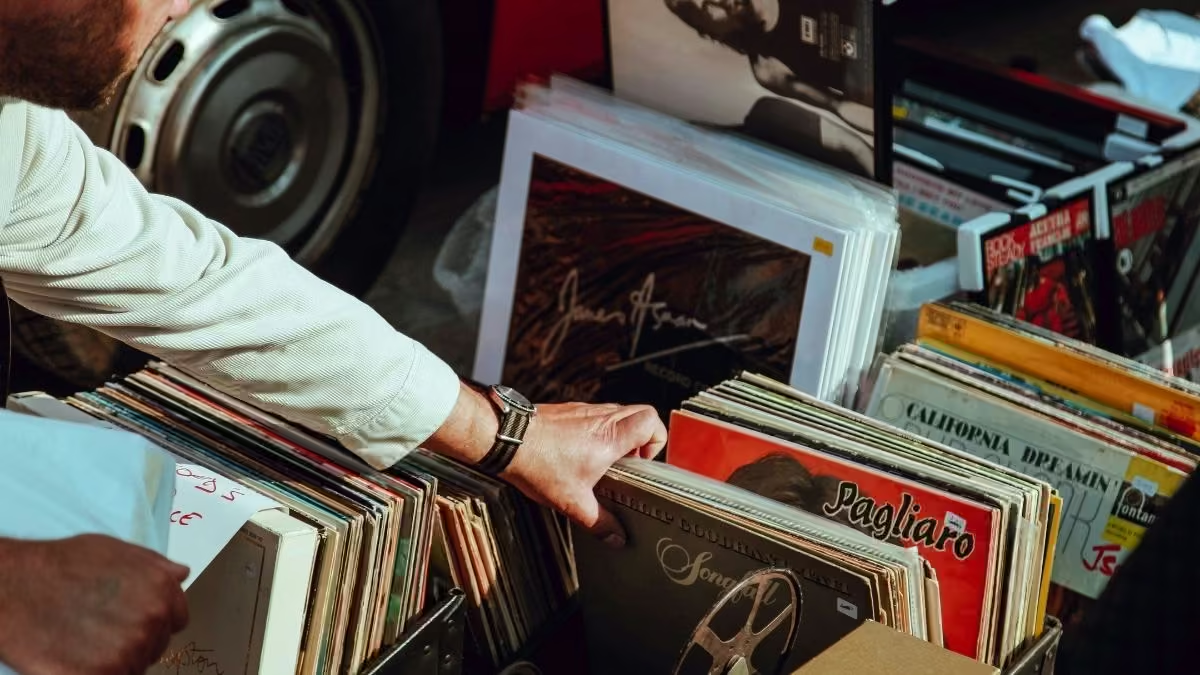
Even setting licensing aside, consumer streaming services are not designed to serve a commercial venue.
Spotify's algorithms are optimised for individual listener retention. They surface tracks based on personal history, skip behaviour, and listening patterns that are built around a single user. Most critically, none of this translates into a physical space, as the algorithm lacks knowledge of your brand identity, customer profile, the pace of your service, or the fact that Friday evening in your restaurant requires a different energy than Monday lunch.
The result is music that is broadly acceptable but commercially inert: tracks jump between tempos, moods shift without logic, and the overall effect is generic – pleasant enough in isolation, but not working for the brand or the customer experience.
Yet, the research into music's effect on commercial environments is consistent. The fit between a brand's sound and its physical space directly influences customer behaviour. Dwell time, purchase rate, and brand perception all respond to how well the music matches the environment, making it clear that a playlist built for headphones on a commute was not created for that purpose.
One of the least discussed consequences of consumer streaming in a business is what happens in practice, away from the head office.
Someone has to manage the music, so they build the playlist, refresh it when it gets repetitive, skip tracks that don’t fit, change the mood when the lunch crowd arrives, and adjust the volume when the venue fills up. In practice, that person happens to be whoever is working that shift, but the issue here is that it's not just music they’re managing. They’re making brand decisions with no brief, zero guidelines, and no visibility from the people who are actually responsible for defining the brand and the brand experience.
And this scenario is how a well-run restaurant ends up with a staff member's Friday night playlist running during a Saturday afternoon family service. This is how explicit content finds its way into venues where it has no place and how the sound of a brand, which may have taken years and significant investment to define, disappears whenever a manager steps out.
Brand consistency in music requires the same centralised control that applies to every other brand asset. Unfortunately, when left to individual staff, brand consistency becomes diluted or fragmented.
DIY music solutions create a category of invisible work that rarely appears in any operational plan:
For a single venue, these issues can be low-level irritations, but for a multi-site operator, the same friction multiplies across every location, absorbing management time that would be better spent elsewhere. Nobody budgets for it because it never appears as a line item, but everyone eventually feels it.
For brands operating across multiple locations, consumer streaming creates a structural challenge in that every site sounds different.
Without a centralised system, each location develops its own approach to music: individual managers make their own calls, and staff build playlists based on their own tastes. One venue feels on-brand; another feels like an entirely different business. Customers who visit multiple sites in your estate, particularly frequent guests or loyalty programme members, will notice the inconsistency even if they cannot name what is wrong.
The thing about brand experience is that it’s not built from individual moments. It’s built from accumulated impressions over time, most of which are subconscious. The sound of your venues is one of the most consistent contributors to that experience, so when it varies, so does the brand.

A professional background music system is not a licensed version of Spotify. It is an entirely different category of product, built for a different purpose.
Curation is designed for commercial environments, not personal listening, meaning that playlists are built around brand identity, customer demographics, venue type, and commercial objectives. The track selection accounts for tempo, energy, mood, and how each song transitions into the next within a physical space.
Daypart scheduling means the music shifts automatically as the trading day progresses: quieter and more considered in slower periods, with more energy as footfall builds. These tailored adjustments are not something a consumer platform can replicate.
Central control means head office sets the sound and the schedule across every location, with permission levels that determine how much, if any, local adjustment individual sites can make. What plays in one location is what plays in all of them, unless you choose otherwise.
Hardware reliability matters too: consumer streaming runs on personal devices not built for continuous commercial use; however, professional systems run on dedicated hardware, monitored remotely, with proactive fault detection and rapid resolution.
Startle's background music service is built for multi-site retail and hospitality brands that need consistent, on-brand music across every location.
✅ Music is managed through Studio, a single centralised platform that gives the head office full visibility and control across the entire estate.
✅ A team of professional musicologists handles all curation, with curators from backgrounds spanning DJing, radio, and music production using a combination of expert judgement and data-backed analysis to cover tempo, energy, mood, and customer behaviour.
✅ Brands can choose from over 100 professionally curated playlists or commission a fully bespoke curation service where playlists are built from scratch around the specific identity and commercial objectives of the brand.
✅ For brands that already have a sound they like, Startle's Spotify Suggests tool analyses an existing Spotify playlist and matches it to a professionally curated equivalent from the Startle library.
✅ Every location runs on a dedicated Startle Player, monitored remotely around the clock.
✅ Relentless Support™ is available 24/7/365, with an average response time of 11 minutes and an average resolution time of 47 minutes. The platform maintains 99.999% uptime.
✅ Hardware and installation are included.
✅ Because music and digital signage share the same platform, they can be scheduled and managed together. The sound and the visual experience of every venue can be aligned from one place.
Many of Startle's clients share a familiar journey, and Pizza Pilgrims is a clear example. When the brand was smaller, its Managing Director was managing their own Spotify playlists across a handful of sites, but as the group grew to twelve locations, that approach became untenable, both operationally and commercially. Moving to Startle gave the brand a professional music strategy that could scale with the business.
That transition, from a consumer workaround to a managed professional service, happens consistently at a certain point in a brand's growth. Music stops being something to 'sort out' and becomes a material question about compliance, brand integrity, and operational sanity.
Music is present in your venues throughout every trading hour, influencing every customer interaction and shaping every employee's working environment. It’s one of the most consistently present elements of the brand experience.
Treating it as a background task or something for a member of staff to manage through a streaming app creates exposure that compounds over time: licensing risk is real, brand inconsistency is real, and the operational burden is real. And, across a multi-site estate, they actively erode what the brand is trying to build.
A professional background music system resolves all of this at the source. Curation, scheduling, central control, hardware, and support are all handled, and the music works for the brand because it is designed to.
Startle works with retail and hospitality brands to deliver consistent, on-brand music across every location.
Get in touch to find out more, or book a free brand discovery call.


Ready to amplify your brand? Get in touch to find out how we can use music and tech to help you achieve your goals.
Elevate your brand with strategic music solutions, designed to build an impactful audio experience.
Amplify your brand with strategic digital signage solutions, designed to build an impactful experience.
Proactive account management, free player replacements, end-to-end support… our Relentless Support™ team are just that - relentless.
Get in touch to find out how we can use music and tech to help you achieve your goals.
Find out more about how we can use music and tech to help you achieve your goals.

With an MA in Music, an MA in Music Psychology, and a Mini MBA in Brand Management… James is one of our Startle geniuses. As Creative Director, it’s his job to produce and execute our music output, making sure everything is sounding, feeling and performing just right for our customers. When he’s not on the clock, James loves to walk the dog, read, lift weights, even dabbling in some music production, and he’s known in the office for his love of Mariah Carey.
Say hello on LinkedInReady to amplify your brand? Get in touch to find out how we can use music and tech to help you achieve your goals.
Elevate your brand with strategic music solutions, designed to build an impactful audio experience.
Amplify your brand with strategic digital signage solutions, designed to build an impactful experience.
Proactive account management, free player replacements, end-to-end support… our Relentless Support™ team are just that - relentless.
Find out more about how we can use music and tech to help you achieve your goals.
Find out more about how we can use music and tech to help you achieve your goals.
Get in touch to speak to our team who are ready to help you amplify your brand. We’d love to hear from you.
Startle Technologies Limited
6 Hillside Farm, Pepper Hill
Great Amwell, SG12 9FX, UK
+44 (0) 203 397 7676
Startle Technologies Limited
Harbour Buildings, Harbour
Road, Kilbeggan, N91 RXC5, Ireland
+353 1 697 2557
Startle International Inc
228 Park Ave S, PMB 88380
New York, NY 10003, USA
+1 646-585-0165


